
The basics
What is skin age – and how is it measured?
Skin age describes how old your skin looks biologically, regardless of how many years you've lived. Two people the same age can differ by several years in skin age – and it's changeable.
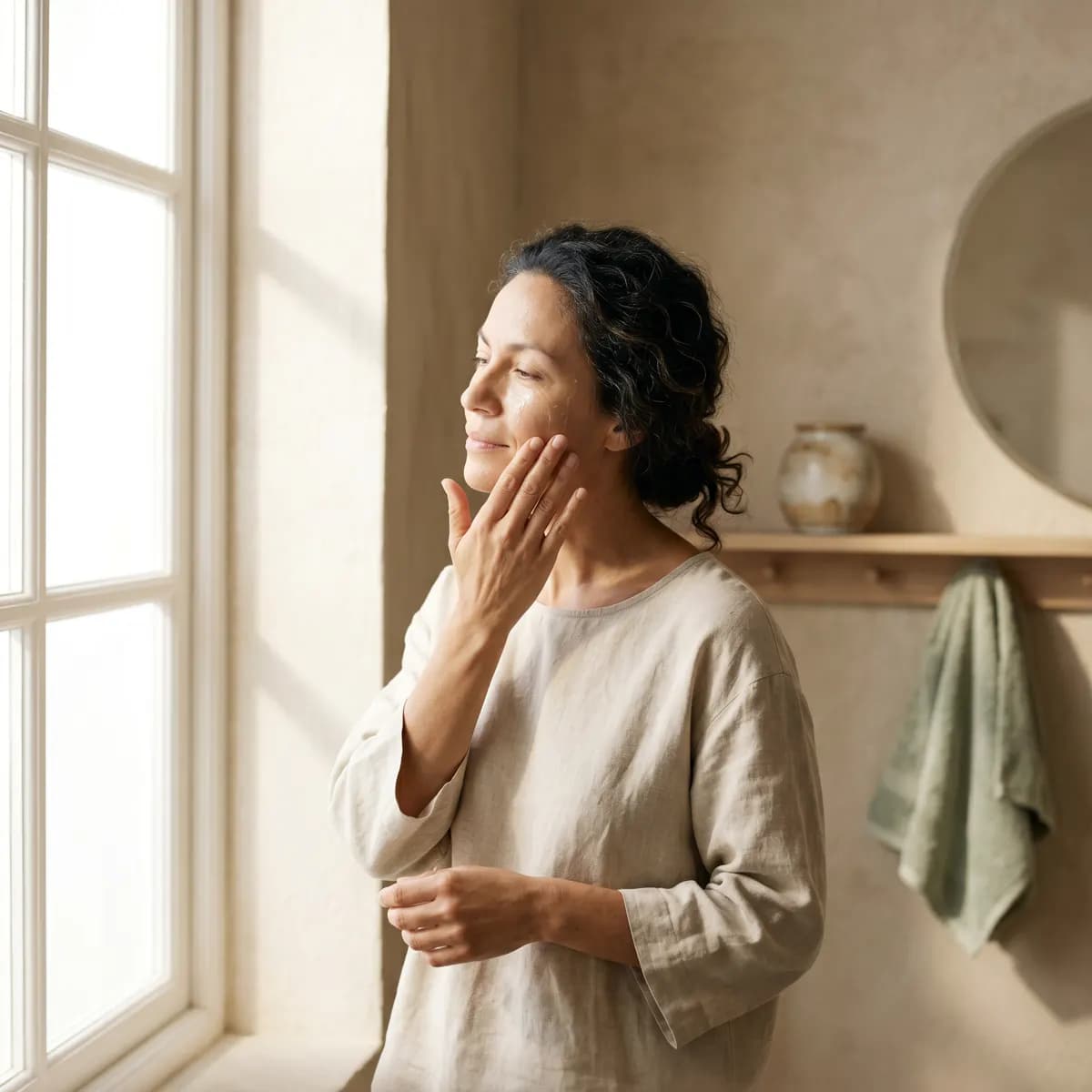
Chronological age is only half the truth
You can't change your chronological age. But your skin's biological age is largely driven by factors you can influence: sun exposure, sleep, diet, stress and skincare routine. That makes skin age a more useful measure than years lived when you want to understand and improve your skin.
What affects your skin age
Sun protection
UV radiation is the single largest cause of premature ageing. Daily sun protection is the most effective anti-ageing step there is.
Sleep
Skin repairs itself during deep sleep. Chronic sleep loss quickly shows up as fatigue, reduced elasticity and increased redness.
Diet and gut
A nutrient-rich diet and a balanced gut flora support the skin's own repair processes from within.
Stress
Prolonged stress raises cortisol, which breaks down collagen and weakens the barrier. Recovery is skincare.
Consistent routine
Regular, gentle skincare that supports the skin's own systems beats expensive treatments that stress the skin.

How to track your skin age
An AI skin analysis estimates your skin age from elasticity, texture, fine lines and evenness. The best way to use the value is to track it over time: run the analysis, improve one lifestyle factor and see whether your skin age moves down.
We believe in a holistic approach. Products can support the skin, but the biggest impact on skin age comes from sleep, sun protection and recovery. Your skin reflects how all of you is doing.
Frequently asked questions
Can you really lower your skin age?
Yes, in the sense that the skin's visible condition – elasticity, hydration and evenness – can improve with better habits and the right routine. It often shows in a repeat analysis.
How accurate is an estimated skin age?
It's a relative measure, not an exact number. It's most useful as a reference point over time rather than an absolute truth.
What affects skin age most?
Sun exposure over time is the dominant factor, followed by sleep, stress and diet.
Sources
- Byrd AL, Belkaid Y, Segre JA. The human skin microbiome. Nat Rev Microbiol 2018;16(3):143–155.
- Bíró T, Tóth BI, Haskó G, Paus R, Pacher P. The endocannabinoid system of the skin in health and disease. Trends Pharmacol Sci 2009;30(8):411–420.
Article reviewed by Christopher Genberg, founder of 1753 SKINCARE.
Related articles
The basics
What is a skin analysis – and what can it actually reveal?
A skin analysis is a structured assessment of your skin's condition. It used to require a therapist ...
The basics
How often should you do a skin analysis?
A single skin analysis gives a snapshot. The real value comes when you repeat it regularly and see h...
Skin Balance
Endocannabinoid system in skin – why your skin wants to self-regulate
Your skin is not built to be bullied. It has its own control network, the ECS, that helps keep oil, ...
Cyclic Skincare
Menstrual Cycle and Skin – why one routine doesn’t fit all
Your skin doesn’t run on a fixed schedule; it runs with your body. Across the menstrual cycle, hormo...
Postpartum Skin
Postpartum skin – why it changes so much
After pregnancy, skin can feel like it belongs to someone else. Hormones drop, sleep gets broken, an...
Ingredient Portrait
cbd for skin – less noise, more balance
CBD for skin is interesting because it doesn’t try to bully the skin into behaving. It works with th...