
The basics
What is a skin analysis – and what can it actually reveal?
A skin analysis is a structured assessment of your skin's condition. It used to require a therapist with a lamp and loupe. Today an AI-based skin analysis can measure 15 skin metrics in under a minute – right on your phone.
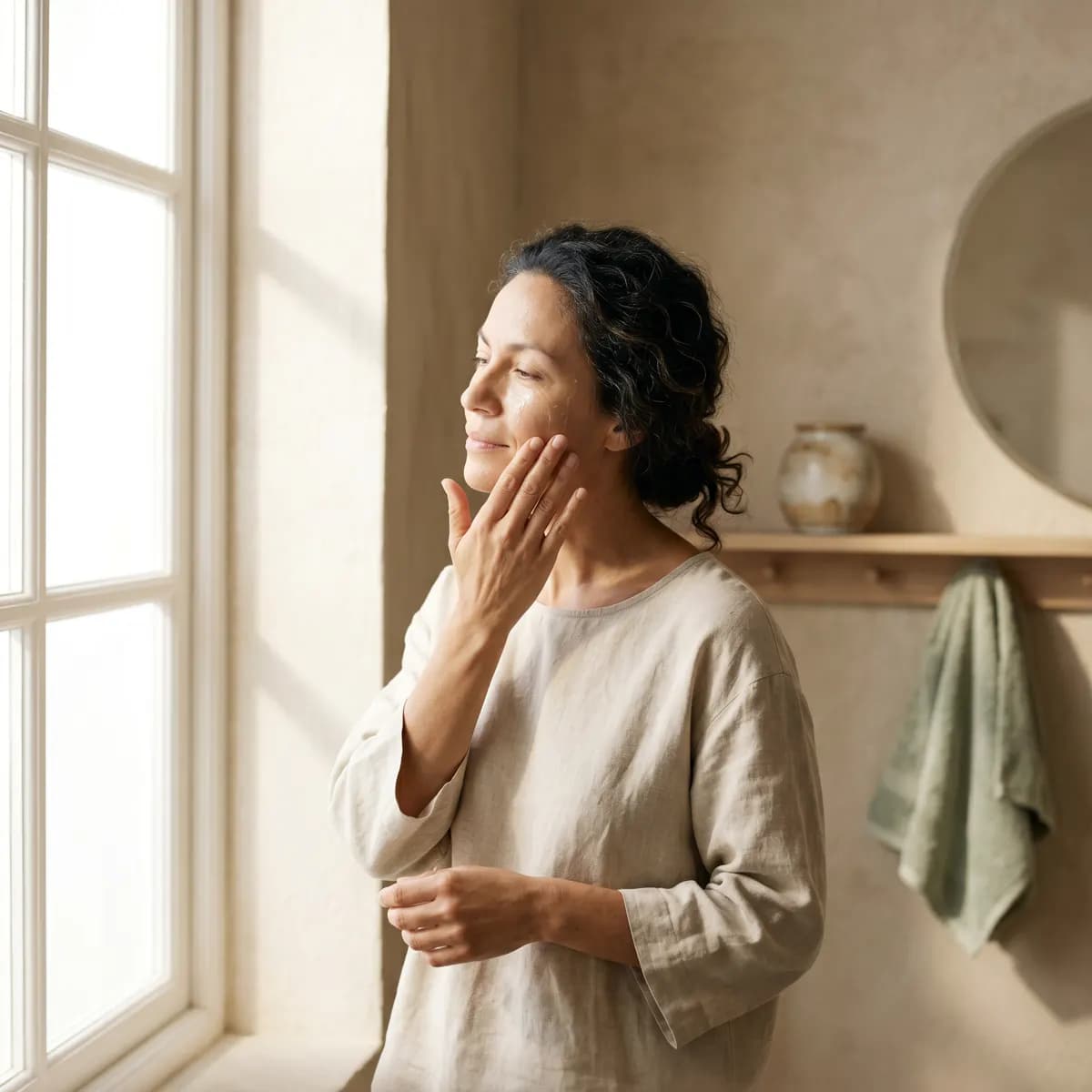
Why guess when you can measure?
Most people choose skincare based on feeling, advertising or a friend's recommendation. The problem is that your skin is unique: the same product can calm one person's skin and irritate another's. Without a baseline it's impossible to know whether what you're doing actually works.
A skin analysis gives you that baseline. Instead of guessing, you get objective values for how your skin is doing right now – and something to compare against a few weeks from now.
What a modern skin analysis measures
Hydration and barrier
How well your skin retains moisture and how strong the barrier is. Low values often show up as tightness, flaking and sensitivity.
Elasticity and skin age
Your skin's firmness compared to your biological age, giving an estimated 'skin age' that's easy to track over time.
Pores and sebum
Pore visibility and oil production across facial zones – the key to understanding combination skin and breakouts.
Redness and evenness
Degree of redness, pigmentation and surface texture. Important for sensitive skin and for tracking inflammation.
Lines and texture
Fine lines and surface smoothness, zone by zone, so you see where your skin needs the most support.

How to do a skin analysis at home
You don't need a clinic. With a free AI skin analysis you take a photo in good light, answer a few questions about your skin and lifestyle, and get a result with 15 metrics, an estimated skin age and a radar chart across 12 facial zones.
What matters isn't a single value but the trend. Run the analysis, follow a simple routine for a few weeks and repeat it. Then you'll see clearly whether your skin is moving in the right direction. Our philosophy is holistic: sleep, diet, stress and movement affect your skin at least as much as the products you use.
Questions fréquentes
Is a digital skin analysis reliable?
An AI skin analysis doesn't replace a doctor, but it gives consistent, comparable readings that are excellent for tracking your skin over time. Always take the photo in the same lighting for best comparability.
How long does a skin analysis take?
A digital skin analysis takes under 60 seconds. You get the result instantly on screen.
Do I need to buy anything to do the analysis?
No. The skin analysis is completely free and requires no purchase.
How often should I repeat it?
Every four to six weeks is ideal – long enough for your skin to respond to changes in routine or lifestyle.
Sources
- Byrd AL, Belkaid Y, Segre JA. The human skin microbiome. Nat Rev Microbiol 2018;16(3):143–155.
- Bíró T, Tóth BI, Haskó G, Paus R, Pacher P. The endocannabinoid system of the skin in health and disease. Trends Pharmacol Sci 2009;30(8):411–420.
Article relu par Christopher Genberg, fondateur de 1753 SKINCARE.
Articles connexes
The basics
What is skin age – and how is it measured?
Skin age describes how old your skin looks biologically, regardless of how many years you've lived. ...
The basics
How often should you do a skin analysis?
A single skin analysis gives a snapshot. The real value comes when you repeat it regularly and see h...
Équilibre Cutané
Système endocannabinoïde peau – pourquoi la peau veut se réguler seule
Ta peau n’est pas faite pour être bousculée en permanence. Elle possède son propre système de régula...
Skincare Cyclique
Cycle menstruel et peau – pourquoi une seule routine ne suffit pas
La peau ne vit pas en mode fixe, elle suit le corps. Pendant le cycle menstruel, les hormones bougen...
Peau Post Partum
Peau post partum – pourquoi elle change autant
Après une grossesse, la peau peut donner l’impression de ne plus parler le même langage. Chute hormo...
Ingrédient
cbd pour la peau – moins de bruit, plus d’équilibre
Le cbd pour la peau est intéressant parce qu’il ne cherche pas à forcer la peau à obéir. Il agit ave...